
Lab 00: General Requirements for PSoC 6 Laboratories
The PSoC 6 microcontroller is a powerful, versatile embedded system developed by Cypress Semiconductor, which is now part of Infineon Technologies. PSoC stands for Programmable System-on-Chip, and it represents a unique approach to microcontroller design that combines a flexible hardware platform with programmable digital and analog components.
PSoC 6 is specifically designed to address the evolving requirements of IoT (Internet of Things) applications. It offers a balance between power efficiency, performance, and security, making it suitable for a wide range of applications, including wearables, industrial automation, smart home devices, and more.
One of the key features of PSoC 6 is its dual-core architecture. It integrates both an ARM Cortex-M4 processor and an ARM Cortex-M0+ processor on a single chip. This dual-core architecture enables efficient multitasking and allows developers to partition their applications into separate tasks, with each core handling specific functions. The M4 core handles high-performance tasks, while the M0+ core handles low-power operations, enabling power optimization and extending battery life in battery-powered applications.
PSoC 6 also boasts a rich set of peripherals and connectivity options. It offers a wide range of analog and digital peripherals, including ADCs, DACs, UARTs, SPI, I2C, USB, and more. Additionally, it supports various wireless protocols, including Bluetooth Low Energy (BLE) and Wi-Fi, and includes integrated hardware security features to protect sensitive data.
What sets PSoC 6 apart from traditional microcontrollers is its programmable nature. It features a unique hardware-based architecture called PSoC Creator, which allows developers to easily configure and customize the integrated components using a graphical user interface (GUI). This flexibility enables rapid prototyping, faster time-to-market, and the ability to adapt to changing project requirements without requiring significant hardware redesign.
In summary, the PSoC 6 microcontroller is a highly adaptable and feature-rich embedded system designed for IoT applications. Its dual-core architecture, extensive peripheral set, and programmability make it an attractive choice for developers seeking a powerful, flexible platform for building innovative, efficient IoT devices.
Cypress Semiconductor, now part of Infineon Technologies, has released multiple versions of the PSoC 6 chip to cater to varying application requirements. Here are some notable versions:
- PSoC 6 BLE: This chip integrates Bluetooth Low Energy (BLE) connectivity with dual-core ARM Cortex-M4 and Cortex-M0+ processors. It enables developers to create IoT devices that can communicate wirelessly with other BLE-enabled devices.
- PSoC 6 WiFi-BT: In addition to BLE, this version adds support for Wi-Fi and Bluetooth connectivity. It combines the power of PSoC 6 with integrated wireless connectivity, allowing developers to create IoT devices that can connect to local networks and the internet.
- PSoC 6 Secure: The PSoC 6 Secure version focuses on enhancing security features. It incorporates hardware-based security features, including a secure bootloader, hardware cryptography accelerators, and secure storage for keys and certificates. These features help protect sensitive data and enable secure communication in applications where security is paramount.
- PSoC 6 + BLE: This version combines the capabilities of PSoC 6 with Bluetooth Low Energy, making it suitable for applications that require both PSoC 6's processing power and BLE connectivity.
- PSoC 6 + WiFi: This variant combines PSoC 6 with Wi-Fi, enabling IoT devices to connect to wireless networks and communicate over the internet. It offers a powerful combination of processing capabilities and wireless connectivity for IoT applications.
- PSoC 6 L-series: The PSoC 6 L-series chips are designed for low-power operation in battery-powered applications. They offer reduced power consumption while retaining the essential features and processing capabilities of PSoC 6.
It's important to note that the specific features and capabilities of each version may vary. Different versions of PSoC 6 are tailored to meet specific application requirements, providing developers with a range of options based on their project needs, including connectivity (BLE, Wi-Fi), security features, and power consumption.
Infineon offers several evaluation boards for PSoC 6 microcontrollers. Here are some notable ones:
PSoC 6 BLE Prototyping Kit
PSoC 6 BLE Prototyping Kit (CY8CPROTO-063-BLE)
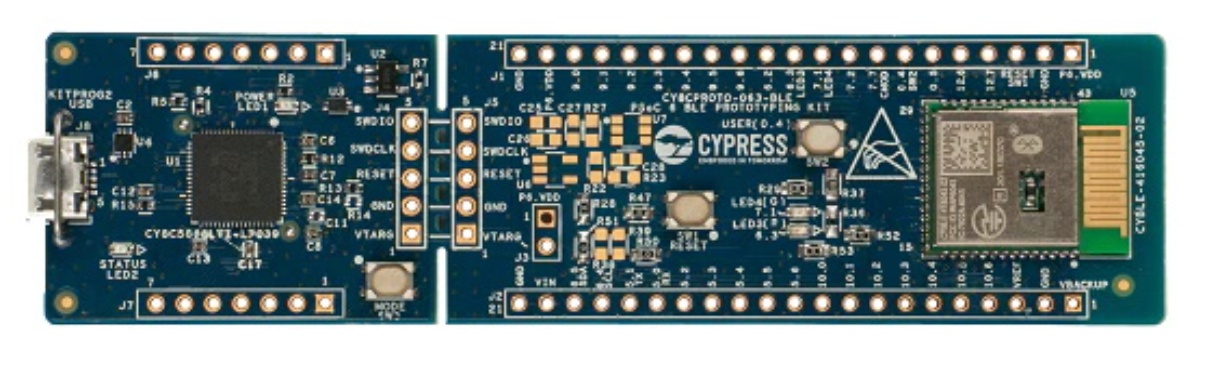
The PSoC 6 BLE Prototyping Kit (CY8CPROTO-063-BLE) is a low-cost hardware platform that enables the design and debugging of PSoC 6 MCUs. This kit features a snap-away form factor, allowing users to separate the KitProg3 (onboard programmer and debugger) from the target board and use it independently.
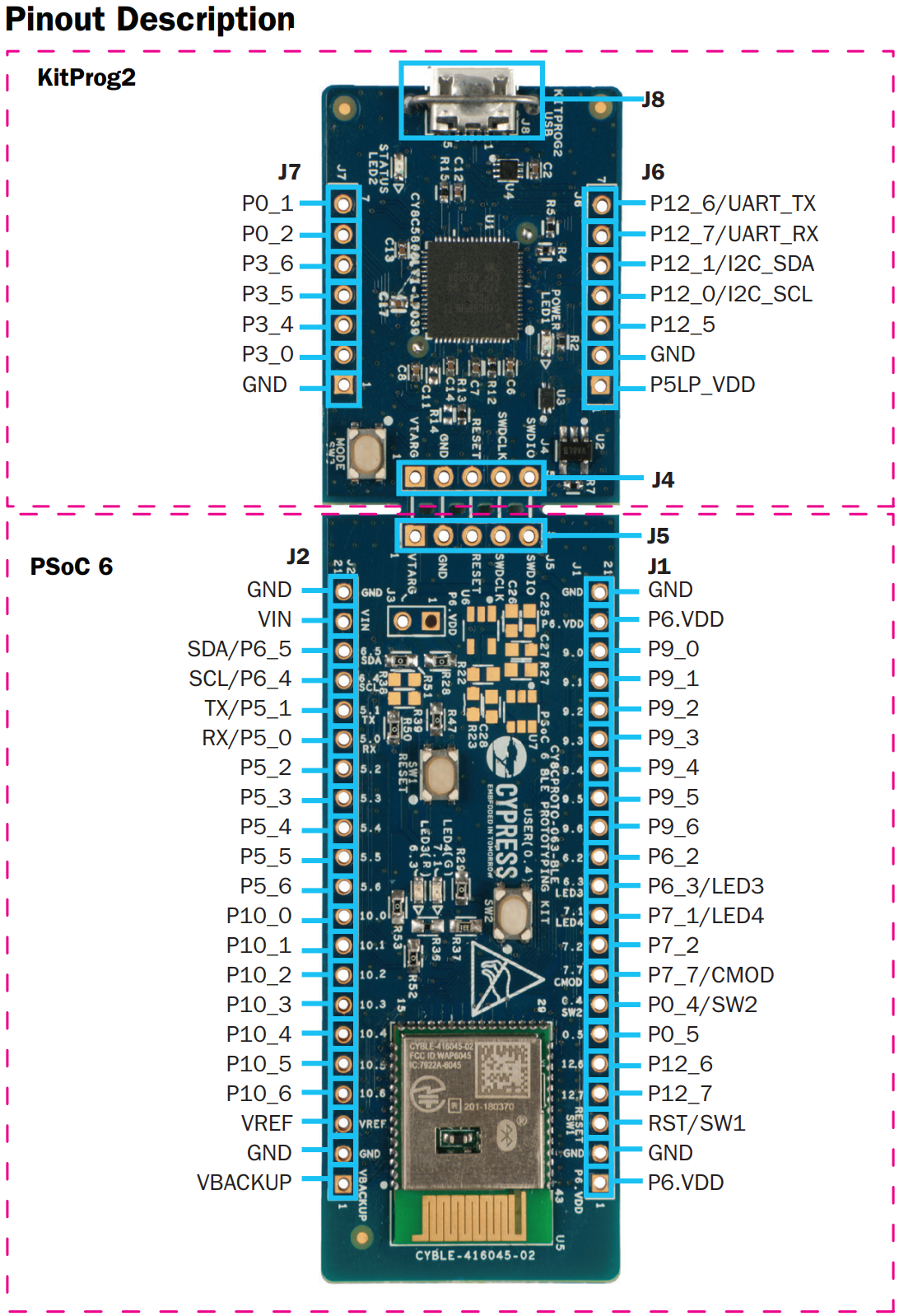
User Manual and Design Data
PSoC 6 WiFi-BT Pioneer Kit
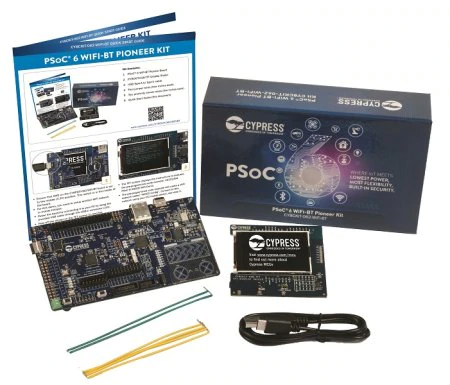
PSoC 6 Wi-Fi BT Pioneer Kit (CY8CKIT-062-WiFi-BT)
The PSoC 6 WiFi-BT Pioneer Kit (CY8CKIT-062-WiFi-BT) is a low-cost hardware platform that enables the design and debugging of the PSoC 62 MCU and the Murata LBEE5KL1DX Module (CYW4343W WiFi + Bluetooth Combo Chip).
User Manual and Design Data
- PSoC 6 WiFi-BT Pioneer Kit Guide
- PSoC 6 WiFi-BT Pioneer Kit Quick Start Guide
- PSoC 6 WiFi-BT Pioneer Kit Hardware
- CY8CKIT-062-WiFi-BT Schematic
Development Tools
PSoC 6-BLE Pioneer Kit
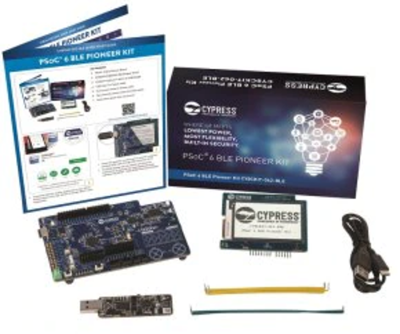
PSoC™ 6-BLE Pioneer Kit (CY8CKIT-062-BLE)
The PSoC 6-BLE Pioneer Kit (CY8CKIT-062-BLE) hardware platform enables the design and debugging of the PSoC 63 Line. The PSoC 6-BLE Pioneer Kit features a single- or dual-core MCU, with an Arm Cortex-M4 and Arm Cortex-M0+, 1MB of Flash, 288KB of SRAM, 78 GPIO, 7 programmable analog blocks, 56 programmable digital blocks, Bluetooth Low Energy, a serial memory interface, a PDM-PCM digital microphone interface, and industry-leading capacitive-sensing with CAPSENSE. The PSoC 6-BLE Pioneer Kit also comes with an E-ink display shield board. This shield board contains an ultra-low-power 2.7" E-ink display, a thermistor, a 6-axis motion sensor, and a digital microphone.
User Manual
Design Data
Development Tools
PSoC 6 Wi-Fi BT Prototyping Kit
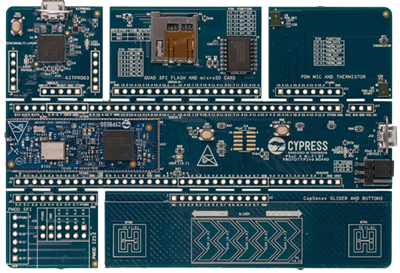
PSoC 6 Wi-Fi BT Prototyping Kit (CY8CPROTO-062-4343W)
The PSoC 6 Wi-Fi BT Prototyping Kit (CY8CPROTO-062-4343W) is a low-cost hardware platform that enables the design and debugging of PSoC 6 MCUs. It comes with a CY8CMOD-062-4343W module, industry-leading CAPSENSE for touch buttons and slider, on-board debugger/programmer with KitProg3, microSD card interface, 512-Mb Quad-SPI NOR flash, PDM microphone, a thermistor. It also includes a Murata LBEE5KL1DX module, based on the CYW4343W combo device.
User Manual
Design Data
PSoC 6 AI Kit
The Infineon CY8CKIT-062S2-AI is a compact, low-power evaluation kit designed specifically for Edge AI and Machine Learning (ML) development. It serves as a hardware platform for collecting real-world sensor data and deploying ML models directly on a microcontroller.
🛠️ Key Hardware Features
- PSoC™ 62S2 MCU: A dual-core processor featuring an Arm® Cortex®-M4 (150 MHz) for heavy tasks and a Cortex®-M0+ (100 MHz) for low-power operation.
- Onboard Sensors: Equipped with a surprisingly wide array of sensors for its "cracker-sized" form factor:
- 60GHz Radar (BGT60TR13C): For presence detection, gesture sensing, and tracking.
- Acoustic: Digital MEMS microphone for sound recognition.
- Motion: 6-axis IMU (BMI270) and 3-axis magnetometer (BMM350).
- Environmental: Barometric pressure sensor (DPS368).
- Connectivity: Includes an AIROC™ CYW43439 Wi-Fi and Bluetooth® combo module.
- Memory: Features 512-Mb Quad-SPI NOR flash and a microSD card interface for data logging
💻 Software & Ecosystem
The kit is tightly integrated with Infineon’s ModusToolbox™ and the Imagimob Studio platform. This ecosystem allows developers to:
- Collect data: Use the out-of-the-box streaming protocol to label data in real-time.
- Deploy "Ready Models": Use pre-trained models for immediate use cases such as siren detection, baby cry detection, and gesture sensing.
- Debug easily: Features an onboard KitProg3 debugger/programmer via USB-C.
🎯 Common Applications
- Wearables: Due to their ultra-low power consumption.
- Smart Home: Presence detection and voice/sound-activated triggers.
- Industrial IoT: Asset tracking and environmental monitoring.